I Stopped Using Vaseline. Here’s What I Use Instead (and Why)
Hi friends!
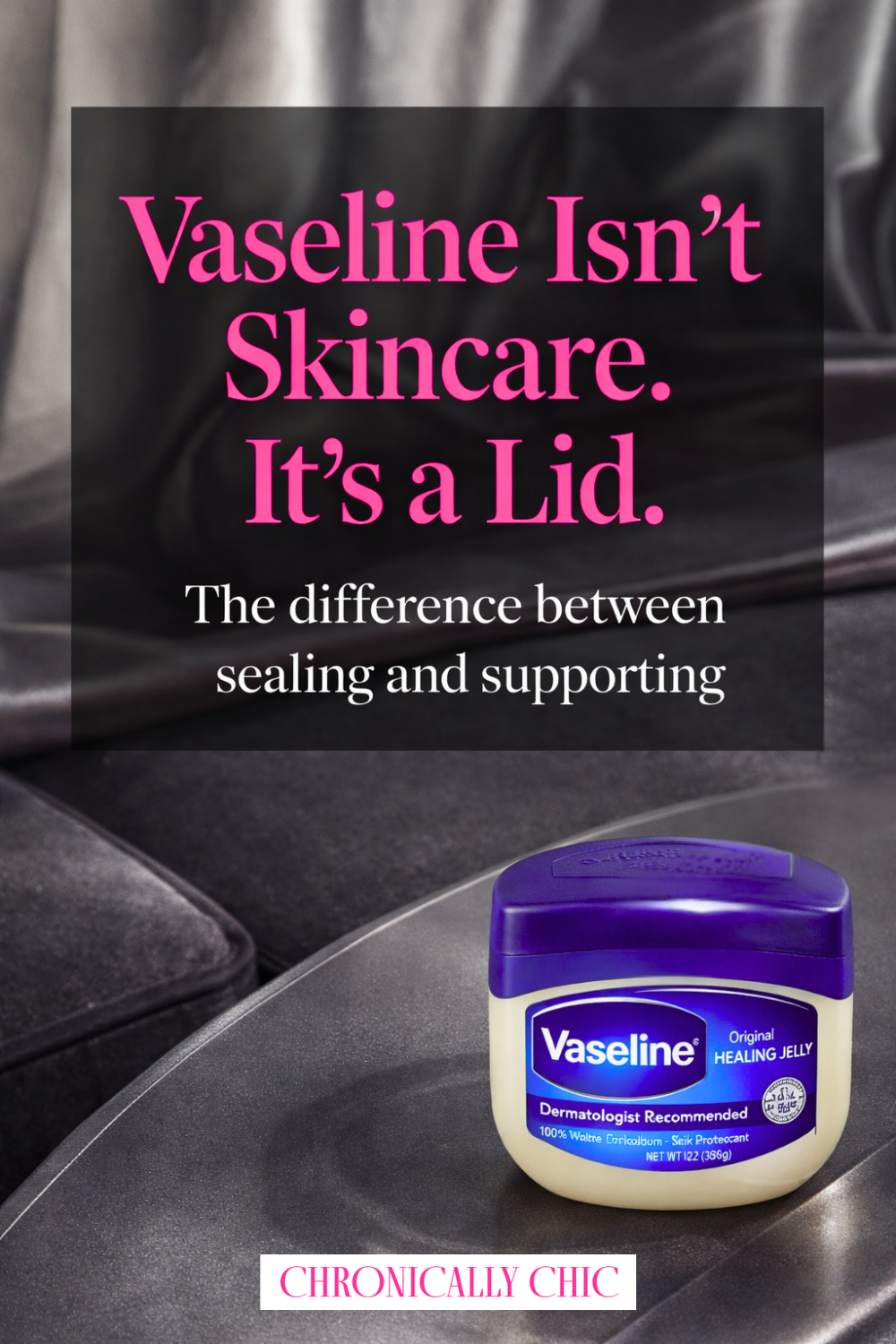
I used Vaseline for years because it works. It seals, it protects, it makes your skin look better fast, but at some point, I realized something that changed how I use it completely: It doesn’t actually improve your skin. It just sits on top of it, and once you see that, you can’t unsee it.
If you’re thinking: “But my skin actually looks better when I use Vaseline…”
I know. Mine did too. That’s honestly why I used it for so long. It makes everything look smoother immediately and you kind of stop questioning it. I just had this moment where I was like… okay but why does my skin only look good when something is sitting on top of it?
What Are Mineral Oil and Vaseline?
Vaseline and mineral oil are petroleum-derived ingredients that function by sitting on the surface of the skin and sealing in what’s already there. That occlusive layer slows water loss.
That effect is often the goal. Occlusion is useful in dry conditions, compromised skin, and short-term flare situations. These ingredients are common because they’re stable, predictable, and very good at doing that one job. Skip relying on Vaseline or mineral oil as your main moisturizer if your goal is long-term skin improvement. Vaseline is good at one thing: sealing.
The problem is that sealing isn’t the same as supporting your skin, and if your skin is dry underneath, you’re just sealing dryness in. My skin always looked fine, but it never got better. That distinction doesn’t come up much because sealing feels helpful.
Why Are These Oils a Problem for Your Health?
Mineral oil and petrolatum are considered inert. They don’t actively interact with the skin the way exfoliating acids or retinoids do.
The more I used heavy occlusives, the more my skin felt like it needed them. This next part surprised me when I first learned it, because it isn’t part of how these ingredients are usually discussed.
Mineral oil has been used in research as an immune adjuvant. In lab settings, it’s literally used to trigger an immune response on purpose. It’s not as biologically passive as most people assume when it’s used often and long-term.
Adjuvants are usually used on purpose, like in vaccines, where the goal is to activate the immune system. When that same immune-stimulating behavior shows up in something applied regularly to the skin, it becomes a different conversation.
When mineral oil does get absorbed, the body can respond by walling it off into tiny pockets of inflammation called granulomas. Over time, that kind of low-grade inflammation helps explain why some people notice more reactivity or less calm overall with frequent heavy occlusive use.
I still keep Vaseline around. I’m not above it, but at a certain point, I realized I was treating it less like an emergency contact and more like a live-in boyfriend. Now I use it the way I think it actually works best: selectively, sparingly, and with boundaries.
How Do These Products Affect Your Skin?
Vaseline and mineral oil seal. That’s the job. They trap what’s already there and keep it from evaporating.
What they don’t do is hydrate or actively support barrier repair. They don’t add anything back in, so if your skin is dry underneath, it stays dry underneath. For short-term relief, that’s enough. For longer-term dryness or sensitivity, it can start to feel like comfort without progress.
Personally, I ended up preferring products that helped my skin feel okay on its own, not just fine as long as something was sitting on top of it.

I stopped leaning so hard on heavy occlusives and started reaching for products that actually hydrate and support the barrier at the same time. Things with ceramides, hyaluronic acid, and certain oils tend to work better for me long-term. My skin holds onto moisture, but it still feels like skin, not like it’s wearing a raincoat.
Jojoba oil in particular makes sense to me. It’s structurally similar to your skin’s natural oils, so it doesn’t just sit there. It absorbs, behaves, and leaves your skin feeling like skin, not coated. I use this one and love it for face, neck, and even flaky cuticles.
If you’re thinking: “So should I never use Vaseline again?”
No. If your skin is cracked, irritated, or needs short-term protection, it can absolutely help. That’s what it’s good at.
The difference is using it on purpose, not out of habit. I just stopped using it as my default “skincare step” and started choosing products that actually support my skin underneath.

Safe Alternatives to Vaseline and Mineral Oil
When people ask me what to use instead of Vaseline on their lips, this is the one I point to without thinking about it. It’s beeswax-based, made with oils the skin already knows what to do with, and it just… works.
If you like the feel of Vaseline but want something that actually supports your skin, this is what I’d use instead:
• Egyptian Magicor Abeille Royale Honey Balm– closest texture, but made with beeswax and oils your skin can actually use
• True Botanicals Calm Ginger Turmeric Balm – lighter, better under makeup, doesn’t sit on top of your skin
• Nécessaire Body Lotion– feels rich without that coated, heavy finish
These don’t just seal. They actually do something.
If you want makeup and skincare that looks put-together without being high-maintenance, what I use is here!
None of this is about doing skincare ‘wrong.’ It’s about understanding what a product is designed to do, and deciding whether that matches what you want long-term.
FAQs About Mineral Oil and Vaseline
Why do so many people swear by Vaseline if it’s not actually improving skin?
Because it “works” immediately. It smooths texture, reduces water loss, and makes skin look more even within minutes. That creates the feeling that it’s “fixing” something, but what it’s really doing is creating a temporary surface effect. That’s why people keep going back to it, even if their underlying skin doesn’t actually change
What does research say about mineral oil and immune signaling?
Research shows mineral oil can act as an immune adjuvant. That means it can stimulate the immune system rather than staying completely passive. In sensitive people, this immune activation has been linked in studies to autoimmune and inflammatory conditions, including lupus, eczema, and rheumatoid arthritis. This isn’t a guarantee or a universal outcome, but it is one reason ‘inert’ doesn’t fully capture how it behaves in every context.
Does your body absorb petroleum jelly?
Yes. With repeated use, petroleum-derived ingredients like mineral oil and petrolatum can be absorbed through the skin. Once absorbed, they can accumulate in fat tissue, the liver, and even circulate in the bloodstream. The body does not easily metabolize or eliminate these compounds, which is why long-term exposure raises concerns rather than short-term or occasional use.
Is mineral oil safe in baby products?
According to regulatory standards, yes. Mineral oil is cheap, shelf-stable, and gives products a smooth texture. The issue isn’t legality, it’s biology. Mineral oil does not nourish the skin, and infants have immature detox pathways, making them more vulnerable to buildup from repeated petrochemical exposure. That’s why some people reconsider its use as a default in baby care, even though it’s still widely used.
Can Vaseline cause skin inflammation or rashes?
It can. While many people use Vaseline without obvious short-term reactions, others experience rashes, irritation, or worsened eczema. This may be due to its heavy occlusive nature, trapping irritants against the skin or triggering mild immune responses to petroleum residues. Over time, this can contribute to ongoing low-grade inflammation in susceptible users.
Why is mineral oil still so common in products?
Because it’s inexpensive, stable, and easy to source. It creates a smooth, “luxurious” feel in products without raising production costs. From a manufacturing standpoint, it’s efficient. From a long-term health standpoint, many people decide the trade-off isn’t worth it, especially when there are alternatives that actually support skin function rather than just coating it.
Can petroleum-based products interfere with hormones?
Vaseline itself is not classified as a hormone disruptor. However, petroleum byproducts as a category include compounds known as xenoestrogens, which can mimic estrogen and interfere with normal hormonal signaling. This doesn’t mean every use causes hormonal disruption, but it does mean petroleum-based ingredients are not as hormonally neutral as they’re often assumed to be.
How do I detox my skin from mineral oil buildup?
You don’t need a dramatic cleanse. The first step is simply discontinuing use so the body isn’t continually re-exposed. Supporting lymphatic flow through gentle exfoliation, massage, and circulation can help, along with using skincare that absorbs and supports cellular function rather than sitting on the surface. The goal is clearance and recovery, not aggression.
Does Vaseline actually moisturize skin?
No. Vaseline prevents moisture loss, but it does not hydrate. It functions like a seal, not a source. Applied over well-hydrated skin, it can help lock moisture in. Applied to dry skin on its own, it mainly seals in dryness, which is why it often feels comforting without improving skin function over time.
Lessons Learned
What changed for me wasn’t my skin. It was my standards. Once I understood what Vaseline does and what it doesn’t, I stopped treating it like a default. I don’t use products purely out of habit anymore.
If you’re trying to figure out what actually supports your skin instead of just sitting on top of it, start here:
✔️ Need product swaps? Check out My Favorite Clean Beauty Alternatives
💌 Want more product tea? Join my newsletter here.
💬 Have thoughts on this? DM me, I live for skincare debates.